Places · 3 min read · updated August 2026
Inside Union Station
What is actually in the building, hour by hour, and how to use it as a living room, a bar, a hotel and a train station at once.
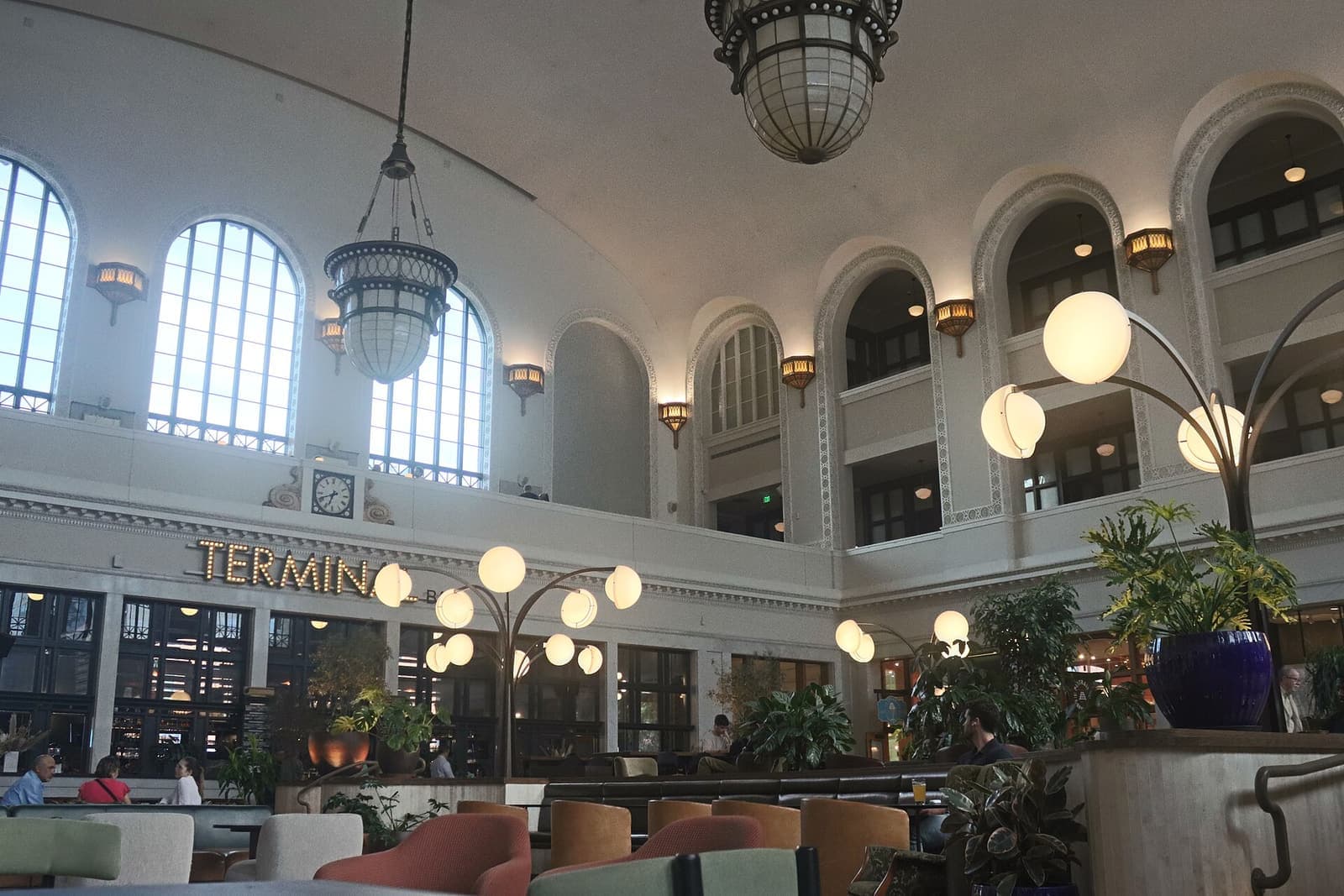
Denver Union Station is three things stacked on top of each other: a working transit hub (train hall behind, bus concourse below, light rail to the west), a hotel and a set of restaurants inside the 1914 building, and a public room, the Great Hall, that anyone can sit in without buying anything. That last part is what makes it different from every other station in the country.
The Great Hall
Walk in from Wynkoop Street. The Great Hall is 65 feet high, ringed by the restaurants, with leather sofas, long tables and a shuffleboard in the middle. You can sit down with a laptop at 7am or a beer from the Terminal Bar at 11pm; the sofas fill by mid-afternoon on weekends and empty out again after 9. It is the best rainy-day room in the city and the default "meet me at" for people who live downtown.
What is inside
Clockwise from the front doors, roughly: the Terminal Bar in the old ticket windows (walk-up beer, a patio on the plaza with free live music on summer Friday evenings); Snooze for the long-line breakfast; Mercantile Dining & Provision, Alex Seidel's restaurant and market; Ultreia for Spanish and Portuguese small plates; Pigtrain Coffee, Milkbox Ice Creamery, and the newer Olive & Finch eatery and Baumé dessert bar (Stoic & Genuine, the seafood room from the 2014 opening, is gone as of 2026); the small Tattered Cover bookshop; and up the stairs at the Wynkoop end, the Cooper Lounge on the mezzanine, the dressed-up cocktail room with the 28-foot windows over 17th Street. Upstairs above all of it are the 112 rooms of the Crawford Hotel.
The plaza out front hosts Urban Markets on selected weekends and the holiday programming in December. Note for anyone reading old guides: there is no farmers market at Union Station in 2026; the Saturday growers' market was replaced by an arts-and-crafts market.
The trains and buses
Through the back doors is the open-air train hall: the A Line to the airport (about 37 minutes, every fifteen minutes most of the day), the B and G commuter lines to the northern suburbs, and Amtrak's daily California Zephyr. Under the train hall, reached by escalators from the hall or from the plaza, is the 22-gate bus concourse for regional and mountain buses. The light rail plaza is at the far west end, past the bus concourse.
A short history
A station opened here on June 1, 1881; it burned in 1894; the current center section, by Gove & Walsh, opened in 1914 and handled eighty trains a day at its peak. By the 1990s Amtrak was the only tenant. RTD bought the site in 2001, moved light rail to the west end in 2011, opened the train hall and bus concourse in 2014, and leased the historic building for 99 years to a partnership that spent $54 million restoring it. The building reopened July 26, 2014, and the Crawford Hotel, named for the preservationist Dana Crawford, opened two weeks earlier. The A Line arrived in April 2016.
Practical
Restrooms are on the lower level near the bus concourse and inside the hall. There is a Whole Foods and a King Soopers within two blocks behind the station on Wewatta and Chestnut. Parking is in the Union Station garage off Wewatta; it is not cheap. And if you have an hour before a train, the Museum of Contemporary Art is a five-minute walk down 15th, and the Cruise Room at the Oxford is a two-minute walk up 17th.