History · 5 min read · updated August 2026
How LoDo happened
Denver started here in 1858, nearly tore the place down in the 1960s, and then, in about thirty years, turned a skid row of empty warehouses into the most-visited neighborhood in the state. The short version, with dates you can check.
Stand at the top of the hill in Commons Park and look back at the skyline. Everything you can see was built on a bet that a gold camp at the meeting of two small rivers would turn into something. The camp was here, at the confluence of Cherry Creek and the South Platte, in the fall of 1858. The gold, mostly, was not.
The river, the tracks, and the warehouses
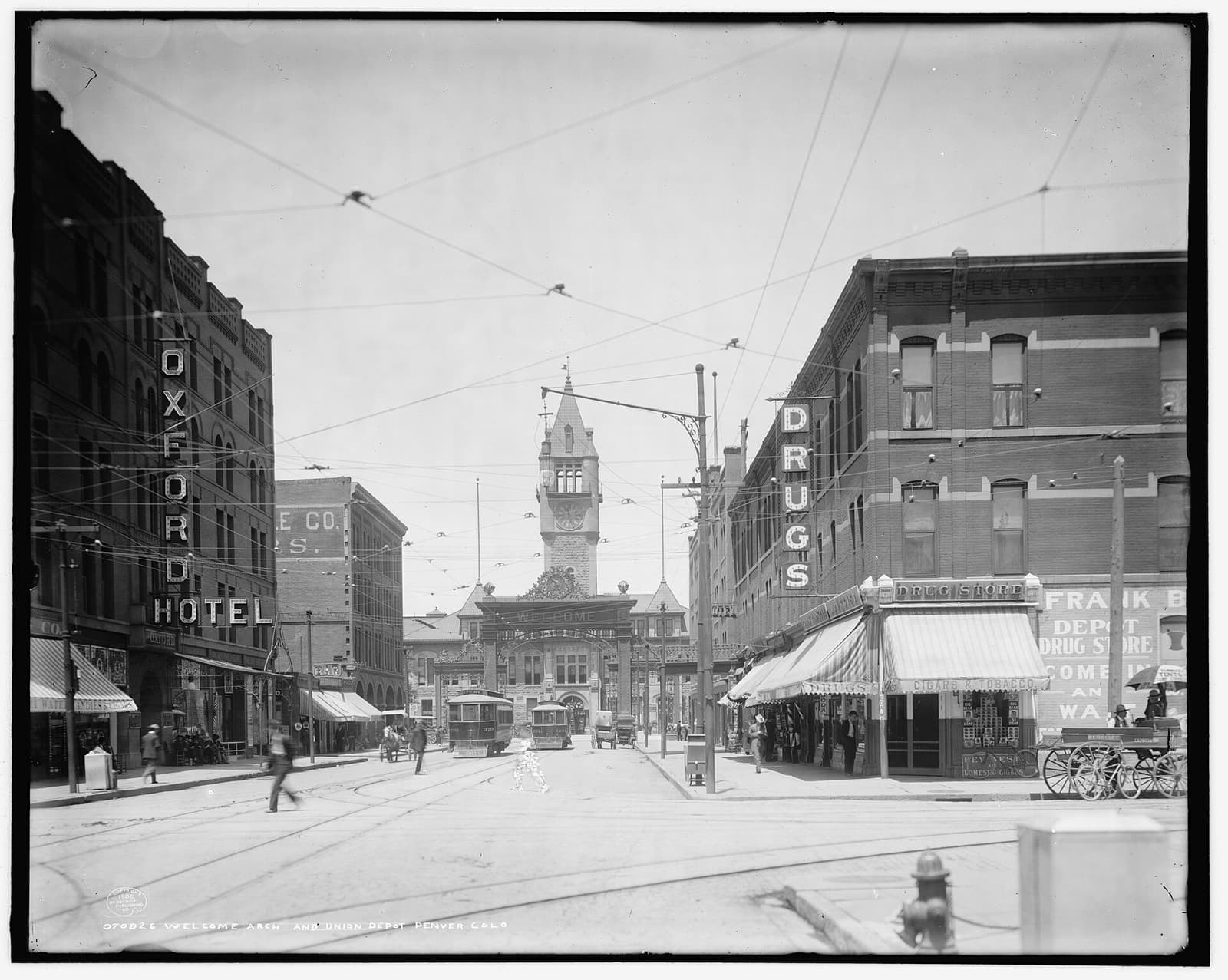
Denver's first decades ran on the railroad, and the railroad ran through the bottomland along the Platte. Union Station opened on Wynkoop Street in 1881, burned in 1894, and got its current Beaux-Arts center section in 1914; at its peak it handled around eighty arrivals and departures a day, and for a while a steel Welcome Arch straddled 17th Street outside it. The blocks between the station and Larimer Street filled with brick warehouses (the Sugar Building, the Ice House, the freight houses on Wynkoop) that moved everything the mountains produced and everything the plains needed. That is the LoDo you see today: five- and six-story brick, big windows, loading docks that are now patios.
Then the trains stopped mattering. By the middle of the twentieth century Lower Downtown was where the city kept what it did not want to look at, and the Denver Urban Renewal Authority set about clearing it. Roughly a fifth of the neighborhood's buildings came down under 1960s and 70s urban renewal. Larimer Street, the city's original main street, was cleared for the whole of its downtown length except one block.
Dana Crawford and one block
That block, the 1400 block of Larimer between 14th and 15th, survived because a woman named Dana Crawford started buying up its Victorian storefronts in 1965 and talked the city into designating it Denver's first historic district in 1971. Larimer Square is now the model everyone points to, but at the time it was a lonely argument. It took another seventeen years, until March 1988, for the City Council to protect the rest: the Lower Downtown Historic District ordinance put demolition controls, height limits and design review over the 127 historic buildings that were left.
The same year a geologist-turned-brewer named John Hickenlooper and some partners opened Wynkoop Brewing in the 1899 J.S. Brown Mercantile building across from a mostly empty Union Station. Wynkoop is usually credited with starting LoDo's revival, and Hickenlooper went on to be mayor, governor and senator, so the story tells well. It is also basically true. Voters approved a $240 million bond issue in 1989, streetscape guidelines followed in 1991, and the neighborhood had a plan.
The ballpark
Ground broke on Coors Field at 20th and Blake on October 16, 1992. An earlier site at 24th and Blake had been rejected because it was too close to a homeless shelter, which tells you what the neighborhood was. The ballpark opened April 26, 1995 (the Rockies beat the Mets 11–9 in fourteen innings), designed by HOK Sport in brick to match the warehouses, with its playing field sunk twenty-one feet below street level so it would not loom. Wynkoop's sales went up by half and stayed there. Every bar on Blake Street between 19th and 22nd exists because of that afternoon.
The same year Elitch Gardens, the amusement park Denver had loved at 38th and Tennyson since 1890, moved to the Platte valley south of the tracks. In 1999 the Pepsi Center opened on the far side of Speer, built with private money for the Nuggets and the newly arrived Avalanche; it became Ball Arena in 2020. Between them the arena and the ballpark put several million people a year on the neighborhood's sidewalks.
Bridges and a station
The 2000s connected LoDo to the river. Commons Park was laid out on the old Burlington Northern railyard around 2000, twenty acres of hill and restored riverbank between the station and the Platte. The Millennium Bridge, the white 200-foot mast at the end of 16th Street, opened in 2002 over the tracks; the Highland Bridge over I-25 followed in 2006. Together with the Platte River Bridge between them, they made a straight walk from the 16th Street shuttle to Platte Street and Highland possible for the first time.
Then Union Station itself. RTD bought the site in 2001. The light rail station moved to the west end in 2011, Amtrak moved into a new open-air train hall in February 2014, a 22-gate bus concourse opened underneath in May, and on July 26, 2014, after a $54 million restoration, the 1914 building reopened with the Crawford Hotel upstairs (named for Dana Crawford, still at it) and the Great Hall as the closest thing Denver has to a public living room. The A Line to the airport followed in April 2016. Museum of Contemporary Art Denver had opened in 2007 in David Adjaye's glass box at 15th and Delgany, and by the late 2010s the last empty blocks were filling: the Dairy Block, a 1916 dairy plant turned hotel-and-food-hall block, in 2017; McGregor Square, the Rockies' own plaza across from the ballpark, in 2021.
Now
The neighborhood in 2026 is somewhere between finished and starting again. The 16th Street Mall spent three years under reconstruction and reopened, renamed simply 16th Street, on October 4, 2025, forty-three years to the day after it first opened. Foot traffic on it is back to about 95 percent of 2019, according to the Colorado Sun's June 2026 numbers, even as the office towers uphill sit nearly forty percent empty. The Rockies went 43–119 in 2025, the worst record of the modern era, and drew 48,000 to Opening Day anyway.
The next chapter is across Speer. In October 2024 the City Council approved Kroenke Sports & Entertainment's plan to build a neighborhood on the fifty-five acres of Ball Arena parking lots (thousands of homes, a park, twenty years of construction), and in July 2026 it approved the Wynkoop Crossing, a pedestrian bridge over Speer that will connect LoDo to the arena directly, expected around 2029. Elitch Gardens, now owned by Kroenke too, opened its 2026 season as usual and says it will keep operating "for the foreseeable future," despite years of rumors about the River Mile development planned for its site. And on the Auraria campus across the boulevard, forty thousand students go to class in the middle of all of it, on ground that was a Latino neighborhood until the 1970s, which is a story that deserves its own page.
That is the neighborhood: a railroad district that lost its railroad, was almost demolished, and was saved by one block, one brewery, and one ballpark. It is worth walking with that in mind.